Same considerations as for prevalence
The considerations regarding prevalence equally apply to incidence: (Prevalence - Considerations).
Loss of participants - Attrition bias
Losing track of participants in a study is common, and may severely bias results if those who are lost are different from those who are kept. Often referred to as attrition bias.
- 100 individuals included in study.
- 30 individuals lost.
- 10 events among the 70 left in the study.
- Risk among retained participants: 10 / 70 = 14.3%.
- If all 30 lost individuals had an event, then true risk: 40 / 100 = 40%.
- If none of the 30 lost individuals had an event, then true risk: 10 / 100 = 10%.
- But we do not know anything about the individuals lost - are they systematically different than those retained?
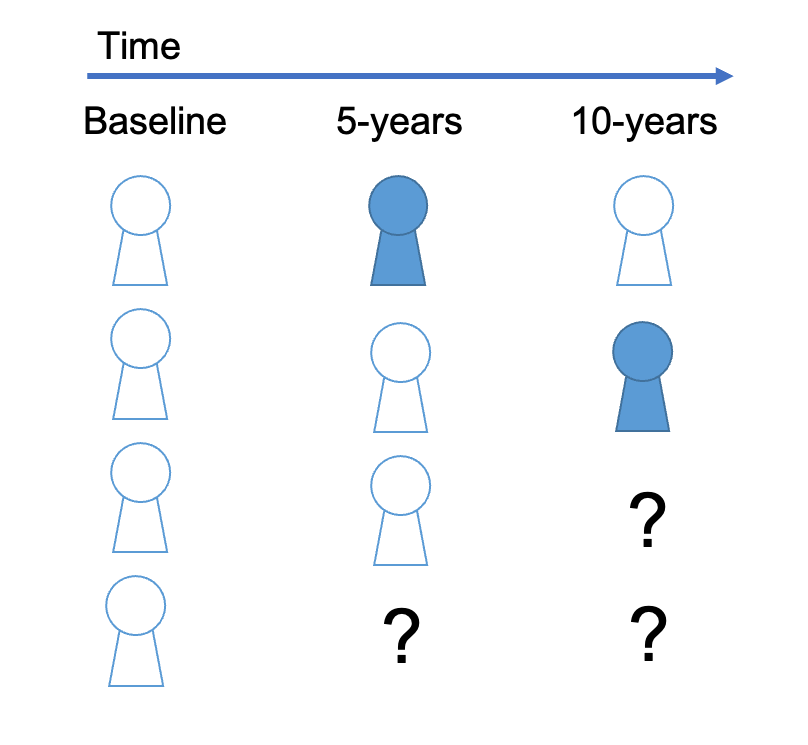
Dealing with missing data is complex, and usually some form of imputation is recommended. However, assuming "worst case" or using the last known value ("carry forward") should not be considered a solution. They may be informative, however, methods such as multiple imputation with chained equations are usually more appropriate.
Recommended reading
Competing risks
In a study of occurrence of obesity, death from heart failure competes with the event of obesity, as once a participant has died they cannot become obese. If measuring all-cause mortality then there are no competing risks, however in most other studies there are.
Censoring
Interval censoring: If measurements are done each year, we do not know what happens inbetween, and we assume that all events over the entire year happend exactly at the time of measurement.
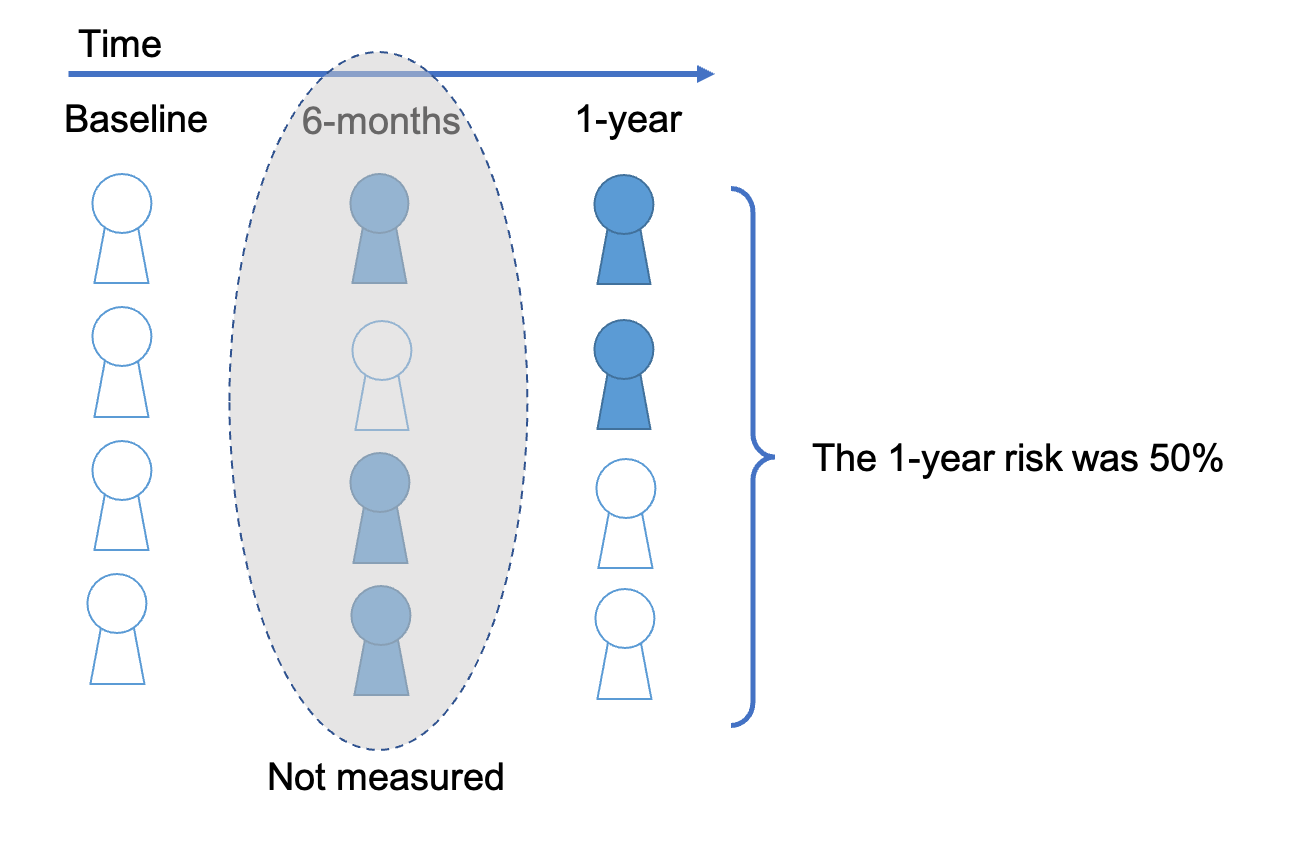
Right censoring: When a subject leaves the study before an event occurs, or the study ends before the event ocurrs, the data is right censored (attrition bias).
Left censoring: If a subject has already experienced the event before enrolment this is called left censoring. This can hopefully be avoided by inclusion critera, but not always. Makes computations incorrect, since we should start with an at-risk group.
Prevalence is not incidence
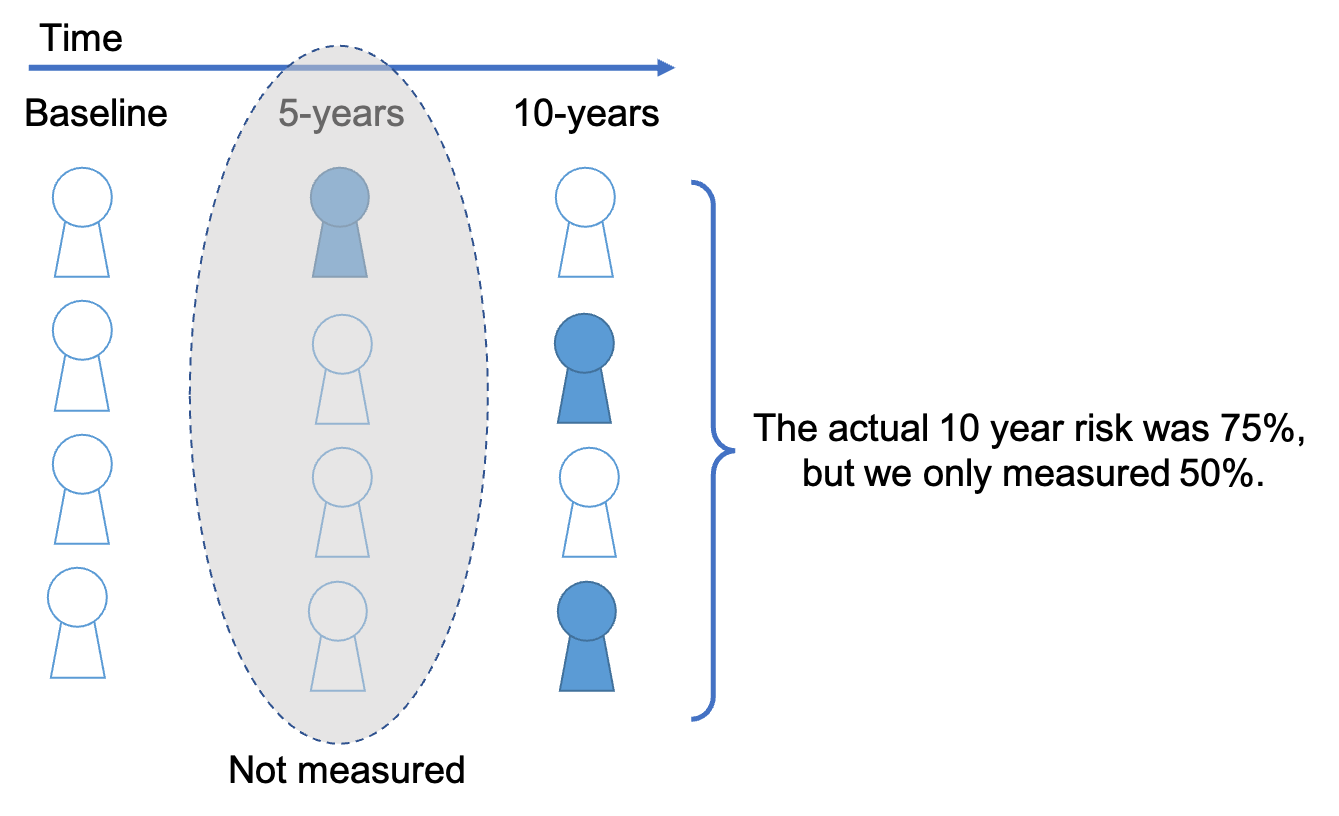
Risky drinking was measured after 10 years in a cohort of non-risky drinkers at baseline. The prevalence proportion of risky drinking was 50%.
- Tempting to say that the 10-year risk was 50%.
- What about those who became risky drinkers but then stopped drinking before measurement?
- Over a shorter time span we may think of prevalence as incidence while being aware of bias from interval censoring.
- Ask participants to recall events last measurments (eg. alcohol consumption).
Proportion vs rate
- If follow-up time is different for different individuals, then the proportion is not accurate, as time was different. Rate may therefore be a better measure.
- Rate can measure multiple events, proportions cannot.
-
Assumes exchangeability among person-years.
- 1 person followed for 10 years contributes 10 person years.
- 10 persons followed for 1 year contributes 10 person years.
- Answers different questions, both may be valuable.